
In This Video:
We operate with the hope that life will go well, and when it inevitably goes wrong, our resistance creates immense suffering. This resistance is the engine of the 'life-death train'—a cycle of reactivity we are all on. But there is a side door, an attainable exit from this machine. It's a different energy field, one you can witness not just in realised humans, but in the quiet stillness of nature itself. This teaching points directly to that available exit.
- When things 'go wrong' for you, where in the body do you first feel the clench of resistance?
- What might it feel like to take the 'side door' in a moment of difficulty, choosing not to engage the story of how things 'should' be?
- Can you sense the 'different energy field' Rohan speaks of when you are quiet among trees or in nature? What is that quality?
TRANSCRIPT
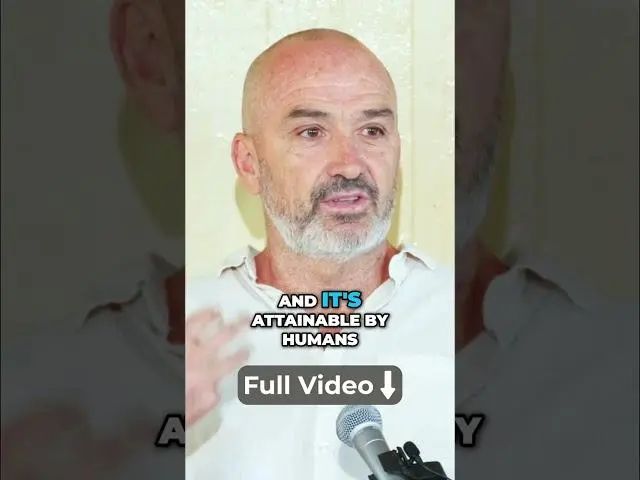
[00:00:13] Life hopefully goes really well, and it's supposed to. And if things go wrong, that's terrible. We don't want that. [00:05:54] But of course, things are going to go wrong, but we resist it. [00:11:78] But there's a side exit, there's a side door off that life-death train. [00:16:89] And it's attainable by humans. [00:20:30] And actually, some plants, trees, and some ground. It's not just humans that can hold this different energy field.
GLOSSARY
-
Kirtan
A form of devotional chanting. Unlike performance music, its purpose is to quiet the analytical mind and open the heart, creating a shared field of presence that supports self-inquiry and meditation. -
Mantra
A sacred sound or phrase used to focus the mind during meditation. It acts as an anchor to prevent the mind from wandering, allowing awareness to settle into its natural state of peace. -
Om Shanti
A Sanskrit mantra for peace. 'Om' represents the primordial sound of existence, and 'Shanti' means peace. Chanting it is an invocation for peace at all levels of being—body, mind, and spirit. -
Satsang
Literally 'meeting in truth.' It is sitting in the presence of a Self-Realised teacher, where the energetic field itself facilitates the recognition of our shared, non-dual nature beyond the egoic 'I'. -
Non-Duality
The direct recognition that there is no fundamental separation between the observer and the observed. In the Toltec sense, it's seeing that the entire 'tonal' arises within the silent, seamless 'nagual'. -
Life-Death Train
A metaphor for the relentless, mechanical cycle of conditioned existence. It's the human tendency to ride the rails of hope and fear, resisting reality until we find the exit. -
The Side Door
An attainable exit from the cycle of suffering. It isn't a destination but a shift in perception—a direct realisation of the silence that exists prior to resistance. -
Resistance
The ego's automatic 'no' to what is. This friction against reality is the primary engine of suffering, keeping one locked on the life-death train. -
Energy Field
The palpable quality of presence or unconditioned consciousness. This is not a mystical idea but something directly observable in nature and in those who abide in the Substratum. -
Attainable
A key term emphasizing that Direct Realisation is not a far-off concept for saints, but a practical, available possibility for any human being willing to look inward.
Q&A
-
What does the mantra 'Om Shanti' mean?
'Om Shanti' is a traditional Sanskrit mantra for peace. 'Om' is considered the primordial sound of all creation, representing the ultimate reality. 'Shanti' translates to 'peace.' Together, they form a powerful invocation for peace in body, mind, and spirit, helping to calm the nervous system and quiet mental chatter. -
What is Kirtan in spirituality?
Kirtan is a form of devotional practice involving call-and-response chanting of mantras and sacred names, often accompanied by music. Its purpose is not entertainment, but to quiet the thinking mind and open the heart. It creates a powerful collective field that makes meditation and self-inquiry more accessible. -
How can I use this music for meditation?
You can use this Om Shanti kirtan as an anchor for your attention. Instead of focusing on your breath, let your focus rest gently on the sound. Allow the music to wash over you without analysis. When the mind wanders, simply guide it back to the chant. This helps to bypass the 'thinking' mind and rest in pure presence. -
What is Satsang?
Satsang literally means 'meeting in truth.' It is the practice of sitting in the presence of an enlightened teacher to experience the peaceful, non-dual energy of your true nature. It uses meditation, self-inquiry, and direct pointing to help you transcend the limited idea of 'I' and realise the substratum of consciousness. -
What is the 'life-death train' in a spiritual context?
The 'life-death train' is a metaphor for the mechanical cycle of human suffering. We operate with the hope that life will go perfectly, and when it doesn't, we resist. This constant push and pull against reality is the train we are unconsciously riding. -
How can I find the 'side door' to stop suffering?
The 'side door' is not found by doing, but by seeing. It is about recognizing the mechanism of resistance itself. When you see the resistance without judging it, a space opens up. That space is the side door—an attainable exit from the cycle of suffering. -
Is this state of acceptance and peace only for advanced spiritual people?
No. The teaching emphasizes that this exit is 'attainable by humans.' It's not a mystical state reserved for a few, but a practical possibility available to anyone. Even plants and trees can hold this quiet energy field, showing it is a natural state of being.
“There’s nothing to add. What you are is prior to beliefs, thoughts and labels.
Here we explore and unveil the ultimate mystery of non-dual being.
Reality.”